
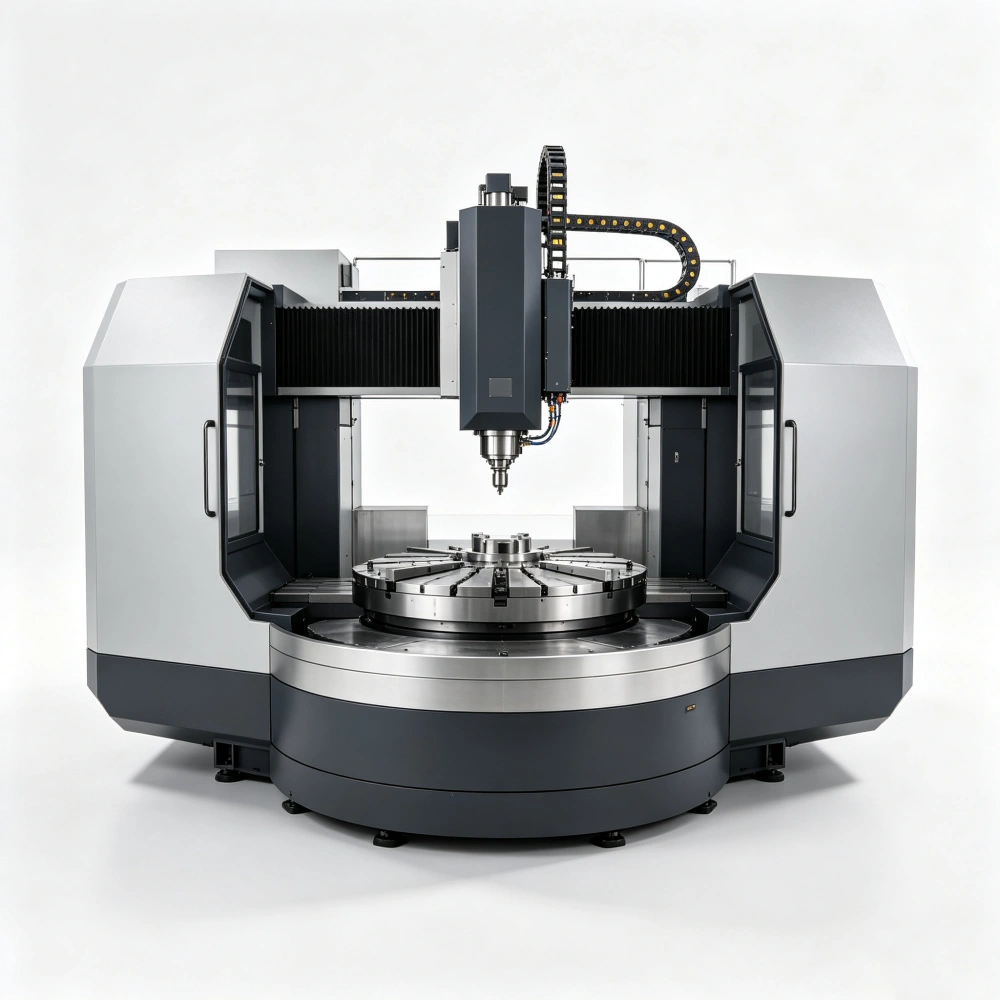
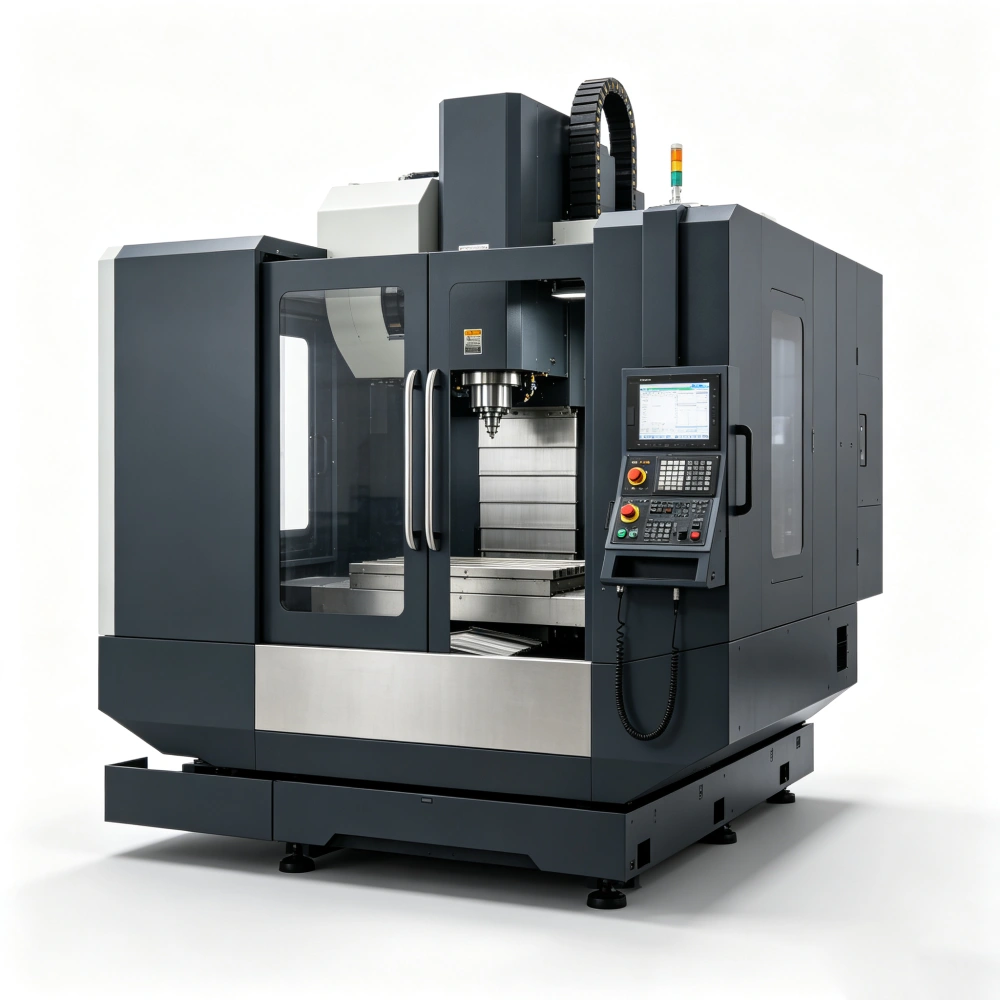
When buyers evaluate machining centers, the first question is almost always the same: “Do I need a 5-axis machine?” It’s a fair question — 5-axis machines cost significantly more than standard 3-axis models. But for many parts, the real answer isn’t “5-axis vs 3-axis.” It’s “true 5-axis vs 3+2 positional machining.”
In this guide, we’ll break down the difference, when each strategy pays off, and how to make the right call for your production line.
What’s the difference between 5-axis and 3+2?
Both setups use a machine with five axes of motion. The difference is how they’re used:
- 3+2 positional machining (also called 5-axis positional): the two rotary axes tilt the part to a fixed angle, then all cutting happens in the standard 3-axis mode. The part is machined in multiple tilted orientations, one after another.
- True 5-axis simultaneous machining: all five axes move continuously during cutting, allowing complex freeform surfaces to be machined in a single setup.
Think of it this way: 3+2 is like photographing a statue from several angles. True 5-axis is like drawing a line around the statue while it spins and tilts at the same time.
When 3+2 machining is the smarter choice
For the majority of industrial parts — brackets, housings, manifolds, and most mold components — 3+2 is the more cost-effective option. Here’s why:
- Higher rigidity: with the table locked at a fixed angle, the machine holds the same rigidity as a 3-axis, allowing heavier cuts.
- Fewer setups: one clamping instead of four or five means better accuracy (fewer error stacking) and less operator time.
- Better tool access: you can reach undercuts and angled features without custom fixtures.
- Lower programming cost: CAM programming for 3+2 is simpler and most shops already know it.
When true 5-axis is worth the investment
True 5-axis simultaneous machining shines when the geometry requires it:
- Complex freeform surfaces — turbine blades, impellers, medical implants.
- Long slender tools — tilting the part keeps the tool short and rigid, improving finish.
- Single-setup high precision — critical for parts where any re-clamping is unacceptable.
- Hard materials where tool engagement must be optimized continuously.
If your parts fall into these categories, a true 5-axis machine is not a luxury — it’s the only way to hold tolerance and cycle time.
| Consideration | 3+2 Positional | True 5-Axis |
|---|---|---|
| Machine cost | Lower | Significantly higher |
| Programming complexity | Moderate | High |
| Rigidity during cutting | High (locked axis) | Lower (moving axes) |
| Best for | Brackets, housings, molds | Turbines, implants, freeform |
| Typical cycle time | Faster for 3D parts | Faster for complex surfaces |
The bottom line for buyers
Here’s our honest engineering advice: don’t buy a true 5-axis machine just to be impressive. If your parts are prismatic — and most parts are — a 3+2 capable machine will deliver 90% of the benefit at 60% of the cost. Invest the savings in better tooling, better CAM, and a faster spindle.
If your parts genuinely require continuous 5-axis motion, make sure you also budget for CAM software, post-processors, and training — that’s where most projects fail, not on the hardware.
Not sure which you need? Send us your part drawings and our applications team will recommend a machine and machining strategy for free.